
Taraz
Ancient Silk Road city and site of the Battle of Talas.

Unknown · CC BY-SA 4.0
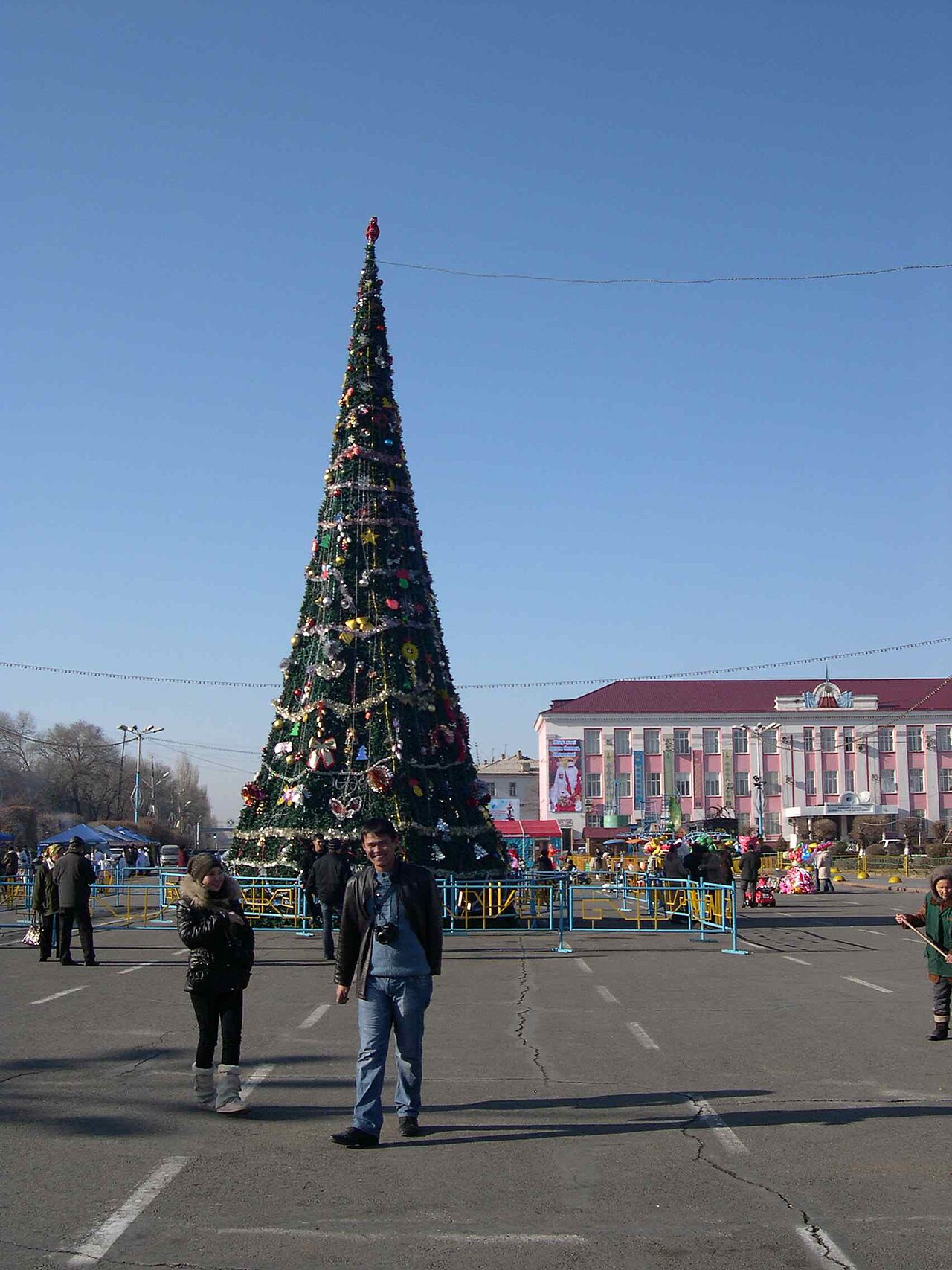
Taraz (also historically known as Talas) is a city in southern Kazakhstan, near the border with Kyrgyzstan, and the administrative center of Jambyl Region. One of the oldest cities in Kazakhstan and in the historical region of Semirechye, it originated as a settlement of the Kangju (Kangar) confederation and was later influenced by Sogdian traders.
- Location
- Talas (Taraz) River, southern Kazakhstan, near Kyrgyzstan border
- Historical names
- Talas, Auliye-Ata, Mirzoyan, Dzhambul, Jambyl, Taraz
Lore & Background
The medieval city of Talas was a major trade center along the Silk Road. One indirect outcome was the introduction of paper to the West via the Arab capture of Chinese papermakers.
Reader's Guide
Taraz's significance lies in its role as a key Silk Road hub and its association with the Battle of Talas, a pivotal conflict that facilitated the spread of papermaking technology to the Islamic world and Europe. The city's 2,000-year history, recognized by UNESCO, reflects layers of Sogdian, Turkic, Arab, Persian, and Russian influence. Archaeological excavations under the Green Bazaar have revealed the ancient city's layout and economic importance. Its multiple name changes—from Talas to Auliye-Ata, Mirzoyan, Dzhambul, Jambyl, and finally Taraz—mirror the region's complex political history. The city's legacy includes the Talas alphabet and its enduring status as a symbol of Central Asian cultural exchange.
Did You Know?
- The runiform inscriptions found in the Talas region are considered a variant of the Orkhon script, but the term 'Talas alphabet' as a distinct named alphabet is not widely recognized.
Ancient Roots and the 2,000-Year Claim
Taraz's claim to being the oldest city in Kazakhstan rests on a remarkable archaeological and textual record stretching back to the first century BCE. The foundation of that claim is a fortress attributed to Zhizhi, a Xiongnu Chanyu, who established a stronghold along the Talas River around 36 BCE — the same site where the Battle of Zhizhi was fought. Long before that, the Talas River valley already bore traces of human activity: bronze-age chest ornaments, statues of kings, and ceramic fragments scattered across the foothills of Karatau and the Talas-Assin oasis point to settlements dating to the bronze epoch. By the seventh and eighth centuries BCE, tribal confederations of Saka Scythians had taken root in the territory. The ancient Sogdians, who would later define the city's cultural character, were the people who built and settled the community that would eventually appear in written records. This layered antiquity — from prehistoric workshops to a Hunnic fortress to Sogdian urban life — gives Taraz a depth of history unmatched by most Central Asian towns.
A Silk Road Crossroads
At the height of the Great Silk Road, Taraz — then known as Talas — functioned as a fortified trading hub where merchants from across Eurasia converged. The Sogdian traders, who dominated the Central Asian stretch of the caravan route, used the city as a springboard for negotiations with both Persia and Byzantium. The city's strategic position in the Talas valley, combined with its mild climate, fertile soil, and rich pastures, made it a natural magnet for stock-breeders, farmers, and long-distance traders alike. Even the Talas alphabet — a local variant of the Turkic runiform Orkhon script — bears the town's name, a testament to how deeply the city's identity was woven into the linguistic and commercial fabric of medieval Central Asia.
The Battle of Talas and the Paper That Changed the World
The clash, fought somewhere along the river in the Talas valley, did not merely redraw the political map of Central Asia — it set in motion a cultural transfer of extraordinary global significance. Among the Abbasid captives taken after the battle were Chinese papermakers, whose craft they carried westward into the Islamic world. This single indirect outcome of a frontier skirmish effectively introduced papermaking technology to the West, a development that would reshape literacy, scholarship, and record-keeping across Europe and the Mediterranean centuries later. For Taraz, the battle cemented the city's place in world history far beyond its regional borders, demonstrating how a modest Silk Road town positioned at the crossroads of empires could become the pivot around which the flow of knowledge between East and West turned.
A City of Many Names
Few places in Central Asia have been renamed as often as Taraz, and each name change mirrors a shift in political power. Today, as the administrative center of Jambyl Region, Taraz sits in southern Kazakhstan near the Kyrgyz border, on the banks of the Talas River.
Gallery


Frequently Asked Questions
What is Taraz?
Taraz is a city in southern Kazakhstan that serves as the administrative capital of Jambyl Region. It sits along the Talas River close to the Kyrgyz border and is widely regarded as one of the oldest urban settlements in the country.
What is Taraz famous for historically?
The city is best known as a key Silk Road trading hub and as the site of the famous Battle of Talas, where Arab and Tang Chinese forces clashed. Its origins trace back to Kangju confederation settlements and later Sogdian merchant communities.
More in Asian Cities 25-35
Elsewhere in the Asian Cities universe
Spotted an error? Know more?
This is a living reference — every entry is fact-audited, and reader corrections feed straight into our audit queue. Suggest an edit · See this site's audit record