
Akita (city)
Capital of Akita Prefecture, Japan, with a history spanning thousands of years.

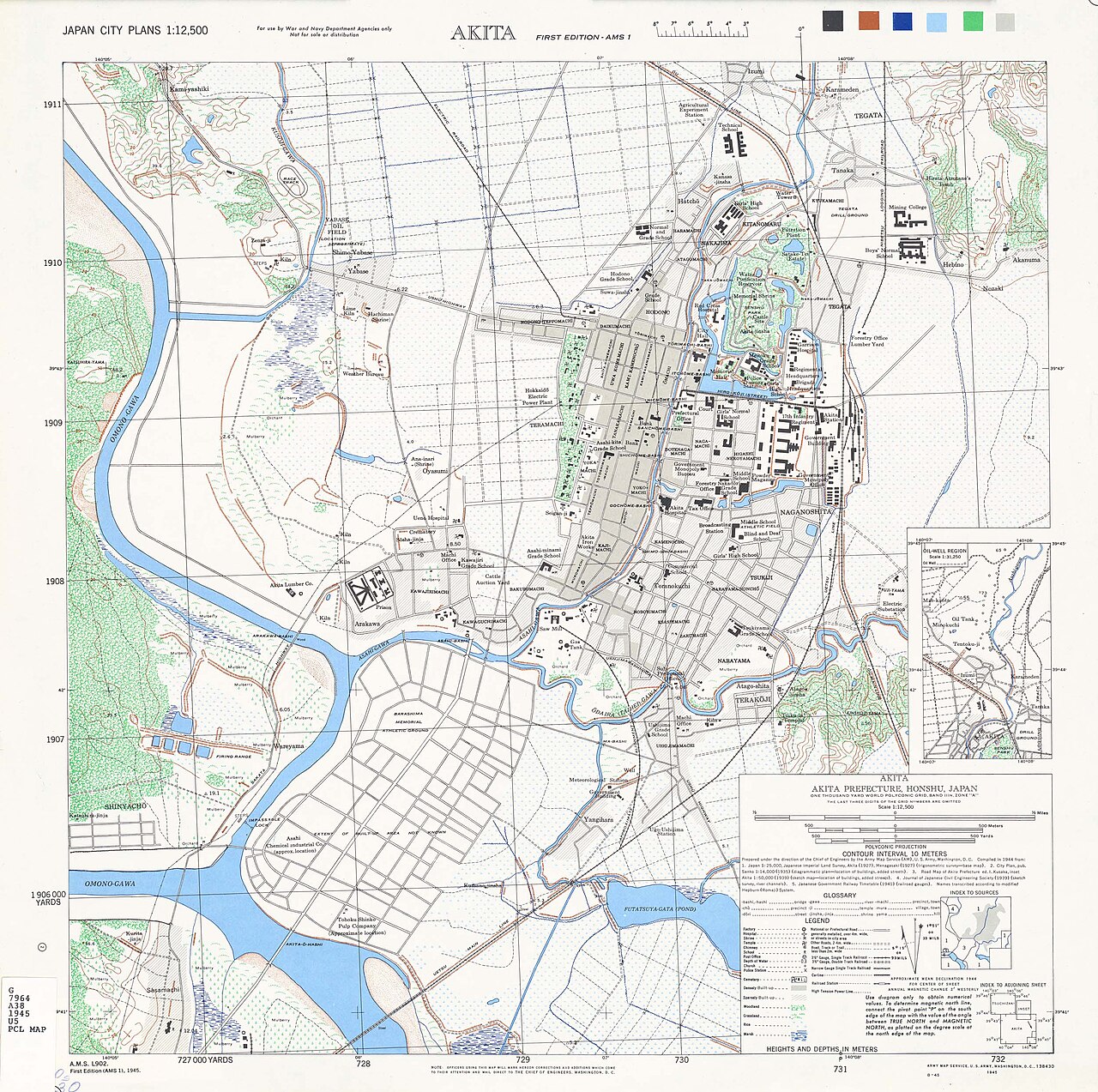
War and Navy Department Agencies · Public domain
The area has been inhabited for thousands of years, with archaeological evidence from the Japanese Paleolithic period through the Jōmon and Yayoi periods.
Lore & Background
The area of present-day Akita was part of ancient Dewa Province. The Jizōden ruins within the city limits are a major archaeological site with artifacts from the Japanese Paleolithic period through the Jōmon and Yayoi periods. The area was ruled by local samurai clans in the Sengoku period, then came under the Satake clan of Kubota Domain during the Edo period, when a castle town developed around Kubota Castle. With the Meiji period, Kubota Domain was abolished, and its castle town divided into the towns of Akita and Kubota. The Akita Shinkansen began operations the same year.
Reader's Guide
Akita's significance lies in its long history as a regional center, from ancient times through the feudal era to its modern role as a core city. Its economy remains heavily dependent on agriculture (particularly rice cultivation), forestry, and mineral extraction, including one of Japan's most important oil fields. The city is home to two regional banks, Akita Bank and Hokuto Bank, and hosts the Akita Thermal Power Station. Akita's location on the Sea of Japan coast, with heavy snowfall and hot summers, shapes its character and economy.
Did You Know?
- The Jizōden ruins within Akita city limits contain artifacts from the Japanese Paleolithic period through the Jōmon and Yayoi periods.
Ancient Roots and Castle-Town Origins
The land that is now Akita has been home to human activity for millennia. Archaeological evidence at the Jizōden site, located within modern city boundaries, reveals artifacts spanning from the Paleolithic era through the Jōmon and Yayoi periods, marking it as one of the region's most significant prehistoric locations. The area fell within the broader Dewa Province during antiquity. After centuries of shifting samurai lordship during the Sengoku period, the Satake clan took hold of the Kubota Domain in the Edo era. Under Tokugawa rule, a structured castle town grew around Kubota Castle, laying the administrative and urban foundations that would eventually become modern Akita.
Forging a Modern City in the Meiji and Taishō Eras
The Meiji Restoration reshaped Akita's identity. When Kubota Domain was dissolved, its former castle town was split into separate Akita and Kubota municipalities.
Climate at the Northern Edge of the Subtropical Zone
Akita sits in a remarkable climatic transition zone, straddling the boundary between humid subtropical (Köppen Cfa) and humid continental (Köppen Dfa) climates. It holds the distinction of being the most populous city at the absolute northern limit of the subtropical zone within Japan, a position comparable to New York City's climatic latitude. The city's coastal position along the Sea of Japan, where the Omono River cuts through the urban center, drives its weather patterns. Summers, by contrast, are hot and humid. Monthly temperature averages swing from a January low of 0.4 degrees Celsius to an August high of 25.0 degrees. Precipitation is spread fairly evenly across the year but skews heavier in the latter months, and more than two-thirds of all days bring some form of moisture, whether rain or snow.
An Economy Rooted in Earth, Oil, and Industry
Akita's economic identity is deeply tied to the land and its resources. Agriculture, particularly rice cultivation, forestry, and mineral extraction remain central pillars of local livelihood. The city is home to one of Japan's most significant oil fields, and oil refining stands as a major industrial sector alongside woodworking, metalworking, and silk textile production. The Akita Thermal Power Station further anchors the city's energy infrastructure. Governance is handled by a directly elected mayor and a 39-member unicameral city assembly, with Akita contributing 12 representatives to the prefectural assembly and forming part of Akita District 1 in the national Diet.
Gallery
More in Asian Cities 1-24
Elsewhere in the Asian Cities universe
Spotted an error? Know more?
This is a living reference — every entry is fact-audited, and reader corrections feed straight into our audit queue. Suggest an edit · See this site's audit record